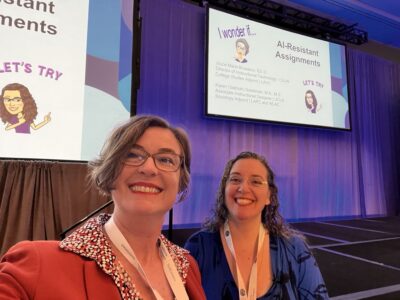
CSUN Presents at the California Community Colleges Online Teaching Conference
Dr. Joyce Marie Brusasco, Director of Instructional Technology and CSUN Alumna, Karen (Sabbah) Sobelman, currently an Associate Instructional Designer at UCLA’s Teaching and Learning Center, presented at the at the 2026 California Community Colleges Online Teaching Conference (CCCTC).
OTC is California’s premier conference for online education, bringing together nearly 1,000 faculty, instructional designers, administrators, and educational technology leaders to share innovative practices that advance teaching, learning, and student success.
This year’s presentation, titled “Designing AI-Resistant Assignments: Fostering Critical Thinking, Creativity, and Authentic Student Voice,” was selected for one of the conference’s featured ballroom sessions to more than 250 attendees, with standing-room-only attendance, reflecting the growing interest in authentic assessment strategies in the age of AI.
The session explored a question many faculty are asking: How do we design meaningful learning experiences in an age where AI can generate polished content in seconds? Rather than focusing on AI detection tools or restrictive policies, the presentation emphasized designing assignments that keep human intelligence at the center of learning. Participants explored practical strategies for creating authentic assessments that encourage students to analyze, evaluate, create, and demonstrate their own thinking throughout the learning process.
Key strategies included:
- Design for higher-order thinking. Create assignments that require students to analyze, evaluate, and create rather than simply recall information.
- Focus on the learning process. Incorporate reflection, drafts, feedback, and revision so students demonstrate how their thinking develops over time.
- Connect learning to authentic experiences. Ask students to apply course concepts to real-world situations, personal experiences, professional practice, or current events.
- Leverage multimodal assessments. Encourage students to demonstrate learning through short videos, audio reflections, annotated artifacts, presentations, or other creative formats that highlight their authentic voice.
- Promote equitable and transparent AI use. Clearly communicate when and how AI tools may be used while designing flexible, accessible assignments that support diverse learners.
As generative AI becomes a regular part of higher education, the conversation is shifting from preventing AI use to designing learning experiences where students must think critically, make judgments, communicate authentically, and demonstrate meaningful understanding. AI can support aspects of the learning process, but it cannot replace human reasoning, ethical decision-making, lived experience, or creativity.
Academic Technology will continue to develop workshops and resources that help faculty create AI-informed, student-centered learning experiences while maintaining academic integrity and supporting meaningful learning outcomes. Watch the Faculty Technology Center workshop calendar this semester for upcoming sessions.